
Haunted Hopeful
Artist: Golareh Safarian
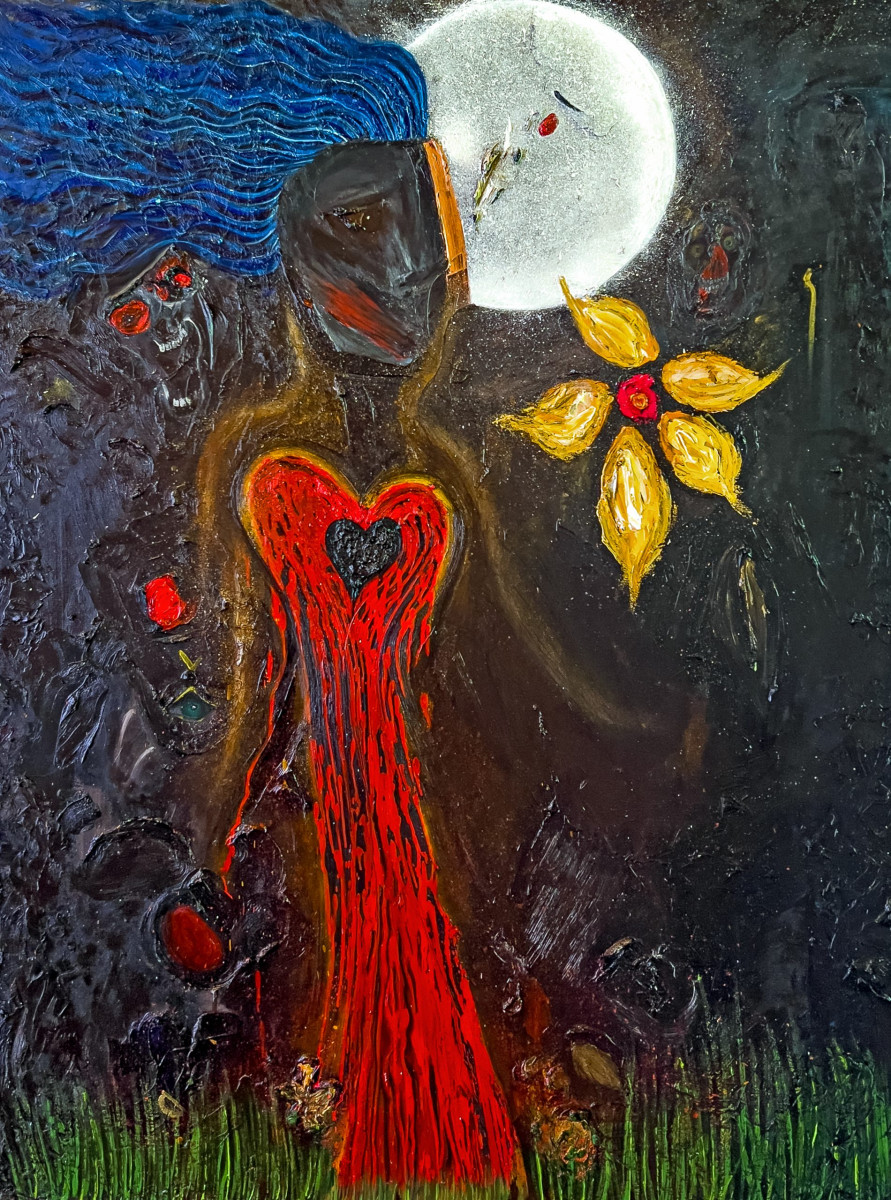
How this artwork fits with the Art of Repair:
Golareh Safarian says:
While my painting “Protest” studies the human experience at a societal level, “Haunted Hopeful” turns inward, exploring the individual experience. Before any depolarization strategy can succeed, the mental health, state of mind, and self-awareness of individuals must align with the desire for collective healing.
To understand polarization, we must first ask what drives individuals to take sides. Often, it stems from personal experiences and genuine discontent with the status quo. For some, this discontent is tied to political identity, beliefs that may be inherited from previous generations. For others, it emerges from religious identity, values reinforced by faith or community. For many, it is also tied to racial identity, shaped by physical characteristics, historical and ancestral experiences, and systemic limitations imposed by governments and societies that continue to influence how we see ourselves and others. But beneath all of these affiliations lies the question of personal identity.
Who are you when you’re alone with yourself? What motivates you? What pains you? What do you love, or fight for, or overlook? How much empathy do you extend to others? Is your empathy universal, or selective toward those who align with your political, religious, racial, or other external identities? And what kind of world do you hope to leave behind?
These questions must be answered on an individual level before true societal repair can begin. “Haunted Hopeful” is an inquiry into that self-awareness, an attempt to understand identity amid constant influence and inner noise. The undefined face of the central figure reflects an identity in flux, shaped by the whispering forces around it. The skeletal forms behind her represent those external influences, their sharper definition suggesting how vividly they imprint upon the psyche.
Only when we recognize and acknowledge these forces can we begin to shed what separates us and move toward what unites us. Understanding how our personal identities are framed and formed is the first step toward depolarization.